Tuesday, September 3, 2013

Think Like a Fish


On weekend mornings, I often get my fly fishing gear out and with my husband head to a stream nearby.  I live in Concord, NH and I am fortunate that there are so many great fishing streams nearby.  I might head west to fish the Contoocook, north up to the White Mountains to fish the Pemi or the Ammonoosuc, west to fish the Isinglass, or even stay in the “city” and fish the Merrimack, Soucook, or Suncook.  On long weekends, we might head further afield to explore a new stream.  One of my favorite trips was up to the north country last fall to fish the Dead Diamond River.  It was a cold but beautiful day and we didn’t see anyone else, the river was all ours.  We didn’t catch any fish but I really loved that river, the big cobbles and the complexity of the habitat.

 Madeleine fishing on the Dead Diamond River.  Photo credit Neil Olson.
When I was learning to fish I was told to think like a fish and I have taken this advice to heart.  When I am choosing a fly I often say: “Well if I was a fish I would think this looks yummy” or walking up to a new stream I say: “If I was a fish, I would live in that pool under that cut bank, it looks cozy”.  Maybe I was a fish in a past life, I feel very at home in or near water.  I love the white noise of water flowing over rocks which helps to calm my often overactive brain.  I spend a lot of my time in streams because in addition to visiting streams for my hobby, I also work in streams.  I am a stream ecologist and I study water quality. 

Since I enjoy fishing, you might wonder why I don’t study fish but I like having a more holistic view of the whole ecosystem.  A healthy native fish community is a great indicator that the stream ecosystem is healthy.  However, monitoring and understanding water quality allows us to detect disturbances to the stream ecosystem early on and potentially address these issues before negative effects cascade to impact the fish.  

I appreciate the streams and rivers of New Hampshire both as a fisherman and a scientist.  For the ecosystems and society project, I am working on understanding how climate change and land development will affect water quality in our rivers.  These two human disturbances are some of the most serious threats to the health of our rivers and understanding how they will affect water quality is necessary to maintain healthy rivers in NH.  Because whether I’m thinking like a scientist or like a fish, I think good water quality is necessary for our rivers, our fish, and ourselves.

Posted by Madeleine Mineau, Research Scientist, Earth Systems Research Center, University of New Hampshire


Tuesday, August 20, 2013

What’s the Dirt on Snow…and Why You Shouldn’t Eat It


Growing up in NH I remember taking a scoopful of snow and dousing it with maple syrup; watching as the snow would magically become the world’s best, most simple dessert.  Those maple syrup snow desserts were a winter dietary staple through my late teens until I learned what could be in that allegedly white, pure snow.  As part of the NH EPSCoR ‘Ecosystems and Society’ Project my colleagues and I have been analyzing the non-snow components (chemical impurities) found within snowpacks throughout the state.  We also look at how these chemical impurities impact the structure of snow grains and albedo, or the amount of light an object reflects, of snow.  
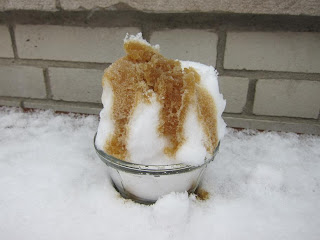
 
Maple Syrup Snow Cone
blog.villagevoice.com Robert Sietsema February 2010
The chemical impurity that has garnered the majority of scientific and public attention is black carbon [EPA Information].  Black carbon is emitted into the atmosphere from the incomplete combustion of fossil fuels such as coal burning, diesel engines and forest fires.  Once black carbon is in the atmosphere it can be collected by snow as it falls to the earth or it can become the condensation nuclei [Definition]of snowflakes.  When black carbon is incorporated into the snow it ‘darkens’ the snow color; reducing its reflectivity or albedo.  Once albedo has decreased the snow pack will absorb more of the sun’s energy which causes additional warming and melting.   Both permanent and seasonal snow cover act as a white t-shirt for the earth, reflecting up to 90% of incoming solar energy and acting to cool the earth’s temperature.  However the reflectivity of the t-shirt decreases when chemical impurities, such as black carbon, become incorporated into the snow and thus can cause an increase the region’s overall temperature.  
 
Albedo data collection.  I am using an Analytical Spectral Device FieldSpec 4 (ASD) to measure the amount of sunlight reflecting off of the snow.  March 2013.  Thompson Farm Pasture, UNH. Photo credit: Luke Barbour.
Daily sampling throughout the 2012-2013 winter season revealed an overall decline in albedo when black carbon as well as other chemical impurity concentrations increased within snowpacks throughout the state.  During periods of rapid melt the albedo decreased by up to 30% over a period of three days while the black carbon increased 12 fold just within the top 5cm of the snowpack!  We have also observed astounding 27 fold increase in black carbon concentration following the blizzard on February 8th – 9th, 2013 (38 cm of new snow).  Understanding the mathematical relationship between an increase in black carbon and decrease in albedo is complex especially with the added factor of how fast snow can settle and increase in density.  For the upcoming 2013/2014 winter we will repeat the snow collection process to gather more data which will help us understand the relationship between albedo and chemical impurities within the snowpack.   

Collection of snow for chemical impurity analysis.  February 2013.  Burley Demeritt Organic Dairy Farm, UNH.
Photo credit: Luke Barbour.
Snow has always been an important climate regulator [Climate Regulator - NASA]because it reflects a great deal of the incoming solar energy back to space.  It is no secret that with shorter winters and more impurity laden snow the effectiveness of snow as a climate regulator could be declining.  The first step to creating cleaner, more reflective snow is to understand how chemical impurities, particularly black carbon, affect albedo within New Hampshire.   Once this relationship is fully understood more effective measures could be taken to preserve our snowpacks and create the white, pure snow so that I along with other NH and New England residents can enjoy the maple syrup snow cones that continuously brought so much joy to the winter season.  

Posted by: Jacqueline Amante, MS Earth Science: Geochemical Systems Student, Institute for the Study of Earth, Oceans and Space, University of New Hampshire

Tuesday, August 13, 2013

Splash into Science! with students investigating the quality of their local rivers and streams.


Splash into Science!
As Plymouth State University Graduate Student, Ashley Hyde looks on, two campers deploy electrical conductivity and stage pressure sensors in the Ashuelot River (Keene, NH)
“Splash into Science” was exactly what students did during their Kids On Campus program at  Keene State College two weeks ago. Steve Hale and I were fortunate enough to facilitate 11 middle school students during the week long session based on the LoVoTECS network data. Students learned how to define a watershed and several ways to assess water quality. Campers battled mosquitoes and lugged sledge hammers, waders, specific conductance meters, PVC housing, rebar and other equipment out to our site on the Ashuelot River to deploy a set of HOBO data loggers. Like the LoVoTECS network, sensors were set to collect temperature, electric conductivity (EC) and water pressure measurements at 3 minute increments. Macroinvertebrates were also collected in buckets and brought back to the classroom for classification. The faces of damselfly larva shocked students at first glance under the dissecting microscopes. The data from macroinvertebrate inventory was combined with the sensor data in order to draw a general conclusion of the Ashuelot’s quality of water. To the students’ surprise, EC levels were 100s of microsiemens lower than their predictions. In order to solidify the concept of how humans influence water quality within watersheds, students participated in a water pollution and land cover graphing activity with Skittles as well as Watershed Bingo. My favorite activity of the week was a concept analysis of the term “watershed.” On the first day of camp, prior to any ground-laying conversations, students were asked to draw a watershed. A majority of them drew an image of a shed with some sort of pipe system inside. On the last day of camp, students were asked to draw a watershed again. This time, their drawings included rivers, tributaries, and mountains along the perimeter, farms, factories, roads and bridges. It was clear that all students had a solid understanding of how to define the term. The students showed off their new vocabulary and summarized their findings by creating posters for a poster session for their parents and guardians. It was really neat to see the students articulate what they had learned during the week. We are working on packaging this week-long curriculum so it may be used in future camps or classroom settings.  

Posted by Ashley Hyde, Graduate Student Plymouth State University and Stephen Hale, Research Associate, University of New Hampshire Joan and James Leitzel Center